AI is changing how companies work — automating routine tasks, surfacing smarter insights, and freeing teams to focus on high-impact work. This article walks through the AI tools that matter (like machine learning and RPA), the real productivity gains you can expect, and practical steps for choosing the right solutions during a digital transformation. If you want help applying these ideas, Valiant Digital can guide the implementation.
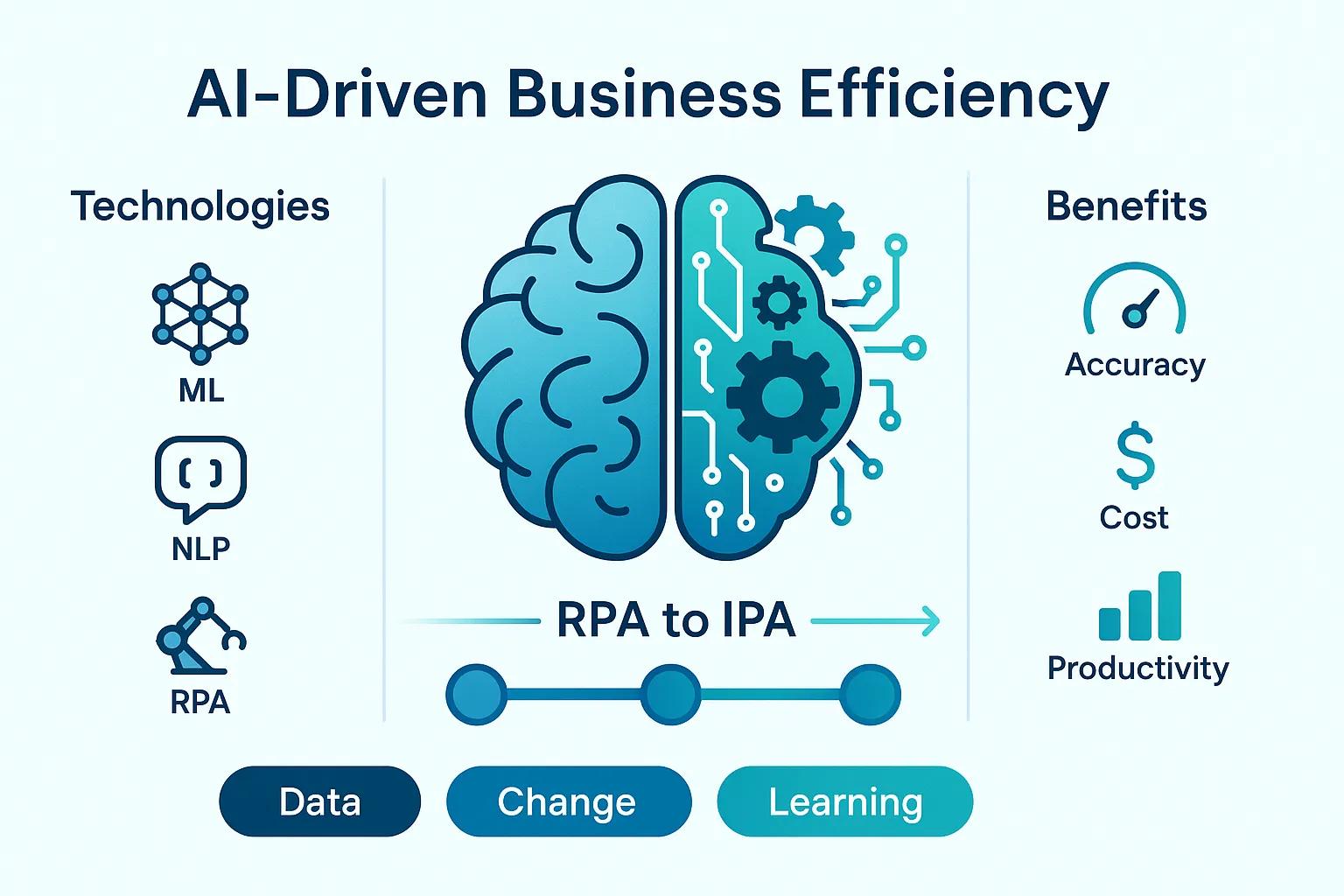
AI technologies are reshaping operational workflows by taking on repetitive work and turning data into decisions. Core technologies — machine learning, natural language processing, and robotic process automation (RPA) — let teams analyze large datasets, forecast trends, and act faster. Integrating these tools doesn’t just cut costs; it unlocks capacity for more creative, revenue-driving work.
Moving from rule-based automation to intelligent systems is one of the biggest shifts in process optimization today.
RPA to IPA: Evolving Business Automation with AI & ML
This survey examines how recent advances in machine intelligence are reshaping business processes. Over the past decade, “robotic process automation” (RPA) has steadily automated repetitive tasks. Now we’re at an inflection point: “Intelligent Process Automation” (IPA) layers machine learning and AI on top of RPA to improve outcomes and handle more complex decisions.
From Robotic Process Automation to Intelligent Process Automation: – Emerging Trends –, T Chakraborti, 2020
How does machine learning improve operational analytics?
Machine learning helps systems learn from historical patterns and get better over time. By analyzing past data, ML models can surface trends, forecast demand, and recommend actions — for example, predicting customer churn, optimizing inventory, or improving delivery schedules. Those insights let teams make faster, more accurate decisions that reduce waste and cost.
Research increasingly shows predictive analytics powered by machine learning is central to efficient operations management.
Machine Learning & Predictive Analytics for Operations Efficiency
This article explores how predictive analytics, built on machine learning methods, enhances operations management. It covers applications in cost control, resource and supply chain planning, and maintenance scheduling. The focus is on improving process resilience and cutting inefficiencies through better forecasting and by embedding analytics into planning cycles.
Predictive analytics based on machine learning as a tool for cost optimization in operations management, 2025
Which practical AI workflow automation benefits improve business efficiency?
AI-driven workflows bring tangible gains that translate to measurable efficiency improvements. Typical benefits include greater accuracy, lower operating costs, and higher employee productivity. Automating routine work reduces error rates and response times — and it gives people time back to work on strategic initiatives that move the business forward.
Increased accuracy: Automation reduces manual mistakes and maintains consistent outputs.
Cost reduction: Streamlined processes lower labor and error-correction costs.
Enhanced productivity: Teams spend less time on repetitive tasks and more time on value-added work.
What are common Robotic Process Automation use cases?
RPA is used across industries to eliminate repetitive, rule-based tasks. Common examples include:
Data entry: Automating inputs and transfers to speed workflows and reduce typos.
Invoice processing: Extracting invoice data and automating approvals and payments.
Customer support: Handling routine inquiries with chatbots so agents can focus on complex issues.
Finance and accounting workflows — especially invoice processing — often show quick ROI from RPA implementations.
RPA for Invoice Processing: Boosting Efficiency & Reducing Errors
Invoice handling is a clear example of RPA’s impact. An RPA solution can capture invoice data, reconcile exceptions, and automate routine decisions that used to require manual review. That reduces errors and cuts the time finance teams spend on routine reconciliation.
Invoice processing using robotic process automation, 2020
These examples show how automating mundane tasks can free up time and reduce operational friction.
How does AI-driven customer service automation enhance operations?
AI-powered customer service tools — chatbots and virtual assistants — respond quickly and accurately to common requests, handle many conversations at once, and escalate only the complex cases to humans. That improves response times and customer satisfaction while lowering pressure on support teams so they can deliver better outcomes on higher-value issues.
How can businesses choose the right AI solutions for digital transformation?
Choosing the right AI tools starts with understanding your operational priorities and where automation will create the most impact. Evaluate solutions for scalability, ease of integration with your systems, and how customizable they are to your workflows. The best choices fit your processes and grow with your business.
What digital transformation strategies support AI integration?
Strategies that make AI integration smoother include:
Data management: Build reliable data pipelines and governance so AI models get clean, consistent inputs.
Change management: Prepare teams for new workflows and clarify how roles will shift alongside automation.
Continuous learning: Support ongoing skill development so your people and systems evolve with the technology.
Together, these practices help organizations capture the full value of AI while reducing implementation risk.
How does Valiant Digital support AI automation implementation?
Valiant Digital helps businesses plan and deploy AI automation in ways that align with their goals and systems. Combining digital strategy, design, and technical delivery, we guide clients from discovery through implementation and training so AI delivers measurable, lasting improvements.
Valiant Digital’s services include:
Consultation: Strategic advice to identify where AI will move the needle and which tools to prioritize.
Implementation support: Technical integration and configuration to make solutions work within your existing stack.
Training: Practical training for teams so they can use and maintain new AI-driven processes confidently.
With this end-to-end support, organizations can adopt AI in a controlled, value-focused way. To explore AI automation with an experienced partner, visit Valiant Digital.
Frequently Asked Questions
What industries can benefit the most from AI automation?
AI automation delivers value across many sectors. Finance benefits from fraud detection and automated reconciliation; healthcare uses AI for data management and decision support; manufacturing gains from predictive maintenance and supply-chain optimization; and retail improves personalization and inventory forecasting. In short, any industry with repetitive processes or large data flows can see gains.
How can small businesses implement AI without a large budget?
Small businesses can start small: use cloud-based AI services with pay-as-you-go pricing, adopt low-code/no-code platforms, or leverage open-source tools. Focus on one high-impact use case, measure results, and scale from there — that approach keeps costs manageable and risk low.
What are the potential challenges of integrating AI into existing workflows?
Common challenges include employee resistance, inconsistent or poor-quality data, and gaps in skills. Overcome them with clear change-management, strong data practices, and targeted training so teams understand how AI augments their work rather than replaces it.
How does AI impact employee roles and job satisfaction?
When implemented thoughtfully, AI removes repetitive tasks and lets employees focus on more strategic, creative work — which can boost job satisfaction. To ease transitions, communicate openly about role changes and invest in reskilling so people move into higher-value responsibilities.
What role does data quality play in the success of AI initiatives?
Data quality is fundamental. AI models depend on accurate, representative, and well-governed data. Poor data leads to unreliable outputs and lost trust. Invest in data cleansing, validation, and ongoing governance to ensure your AI delivers consistent, trustworthy results.
Can AI solutions be customized for specific business needs?
Yes. Many AI solutions are configurable or can be extended to match industry and process requirements. Customization can include adjusting algorithms, integrating with legacy systems, or building tailored features to address specific workflow challenges.
Conclusion
Adopting AI thoughtfully can drive measurable efficiency: fewer errors, lower costs, and more productive teams. The key is choosing the right technologies, preparing your data and people, and partnering with experienced teams to implement solutions that stick. If you’re ready to explore tailored AI strategies, Valiant Digital can help you start your journey toward smarter operations.